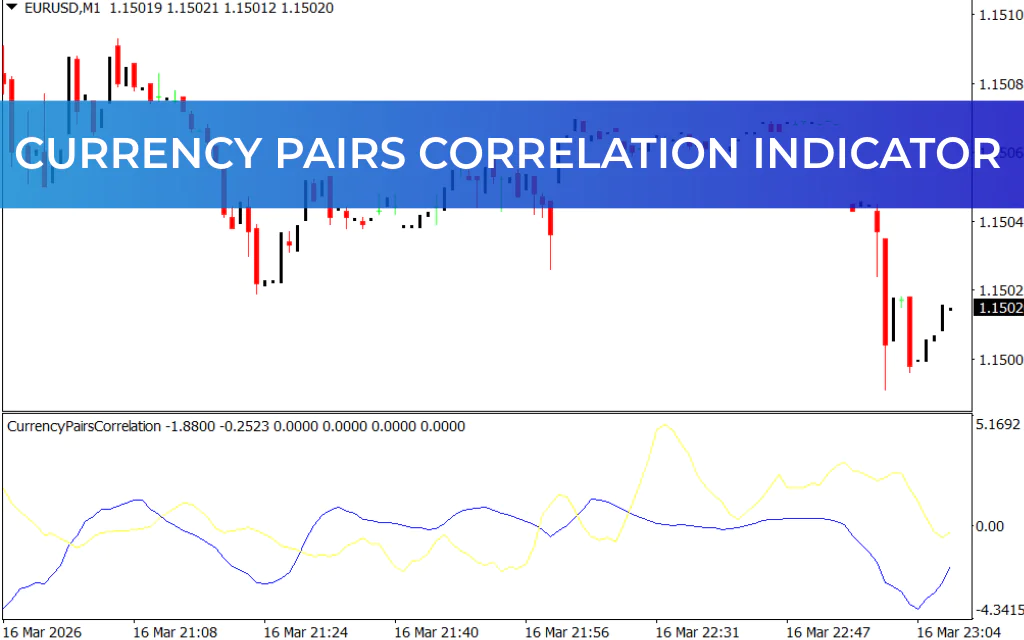
The Currency Pairs Correlation Indicator for MetaTrader 4 (MT4) is a powerful tool designed to help forex traders understand the relationship between different currency pairs. By analyzing the average price movement between two pairs over a selected timeframe, the indicator reveals whether the pairs move together, move in opposite directions, or behave independently.
Understanding currency correlation can give traders a strategic advantage in the forex market. With this indicator, traders can quickly identify the relationship between pairs and use that information to confirm trends, diversify trades, or hedge risk effectively.
How the Currency Pairs Correlation Indicator Works
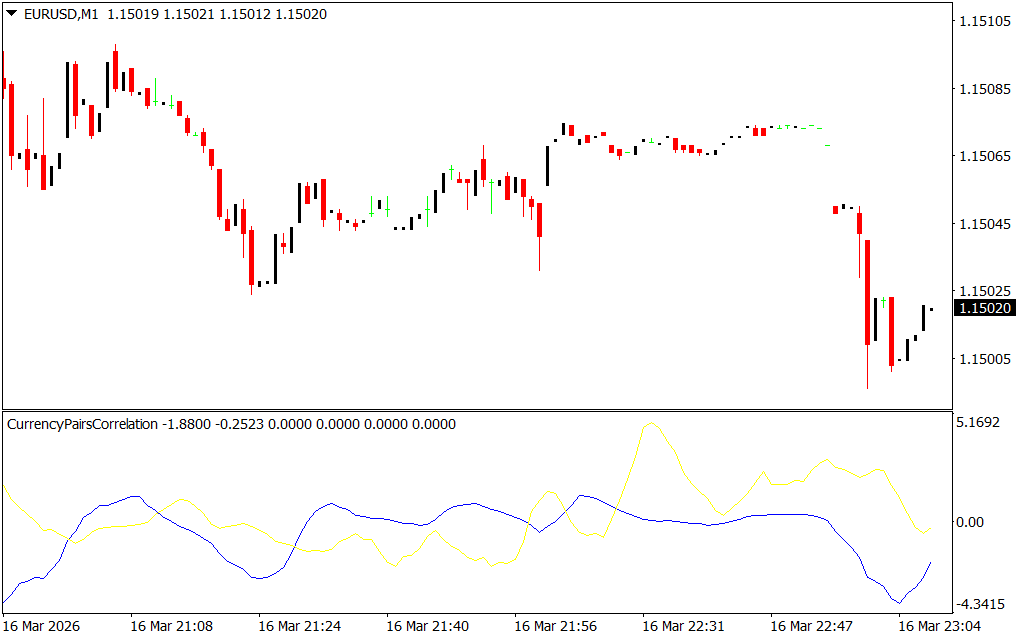
The indicator measures the correlation between two currency pairs and presents the results visually in the indicator window. Instead of displaying the data as a table, chart, or calculator like many traditional correlation tools, this indicator uses a clear histogram display.
- Green Histogram: Shows positive correlation between currency pairs.
- Red Histogram: Indicates negative correlation between currency pairs.
This visual representation makes it easy for traders to quickly interpret the relationship between pairs and react to market changes.
Types of Currency Pair Correlation
The indicator provides insights into three main correlation scenarios:
1. Positive Correlation
Positively correlated currency pairs tend to move in the same direction. When one pair rises or falls, the other usually follows.
Examples of positively correlated pairs include:
- GBPUSD and GBPJPY
- AUDUSD and XAUUSD
- EURUSD and NZDUSD
- GBPJPY and EURJPY
- USDJPY and EURJPY
- AUDUSD and USDCAD
Traders often use these correlations to confirm trend changes. If one pair shows a new trend, the correlated pair can help validate the move.
Additionally, some traders distribute trades across correlated pairs to diversify risk, as each pair may react slightly differently to market conditions.
2. Negative Correlation
Negatively correlated currency pairs move in opposite directions. When one pair rises, the other tends to fall.
Examples include:
- EURUSD and USDCHF
- EURGBP and GBPUSD
Forex traders frequently use negatively correlated pairs for hedging strategies. By opening opposite positions in correlated pairs, traders can reduce potential losses and manage risk more effectively.
3. No Correlation
Sometimes currency pairs move independently, showing little or no relationship. The indicator helps identify these situations, allowing traders to avoid relying on correlation signals when pairs behave randomly.
Trading with the Currency Pairs Correlation Indicator
For example, on an EURUSD chart, the indicator can compare the correlation between EURUSD and USDCHF, which are typically negatively correlated. When the histogram changes color, it signals a potential shift in the correlation or trend direction.
Traders can confirm this change by checking the price movement on both currency pairs before making a trading decision.
Benefits for New and Experienced Traders
Many new traders mistakenly open positions in negatively correlated pairs at the same time, which can effectively cancel out profits. The Currency Pairs Correlation MT4 Indicator helps traders avoid this common mistake by clearly showing the relationship between pairs.
Experienced traders, on the other hand, integrate correlation analysis into advanced strategies such as:
- Portfolio diversification
- Hedging strategies
- Multi-pair Trend Confirmation
- Risk management optimization
Conclusion
The Currency Pairs Correlation Indicator for MetaTrader 4 is an essential tool for traders who want to better understand how currency pairs interact with each other. By providing a clear histogram view of correlation strength, it helps traders confirm trends, hedge positions, and manage risk more effectively.
Whether you are a beginner or an experienced forex trader, this indicator can significantly improve your trading decisions by giving you deeper insight into market relationships.
FAQ
3 Downloads
Published:
Mar 16, 2026 18:09 PM
Category: